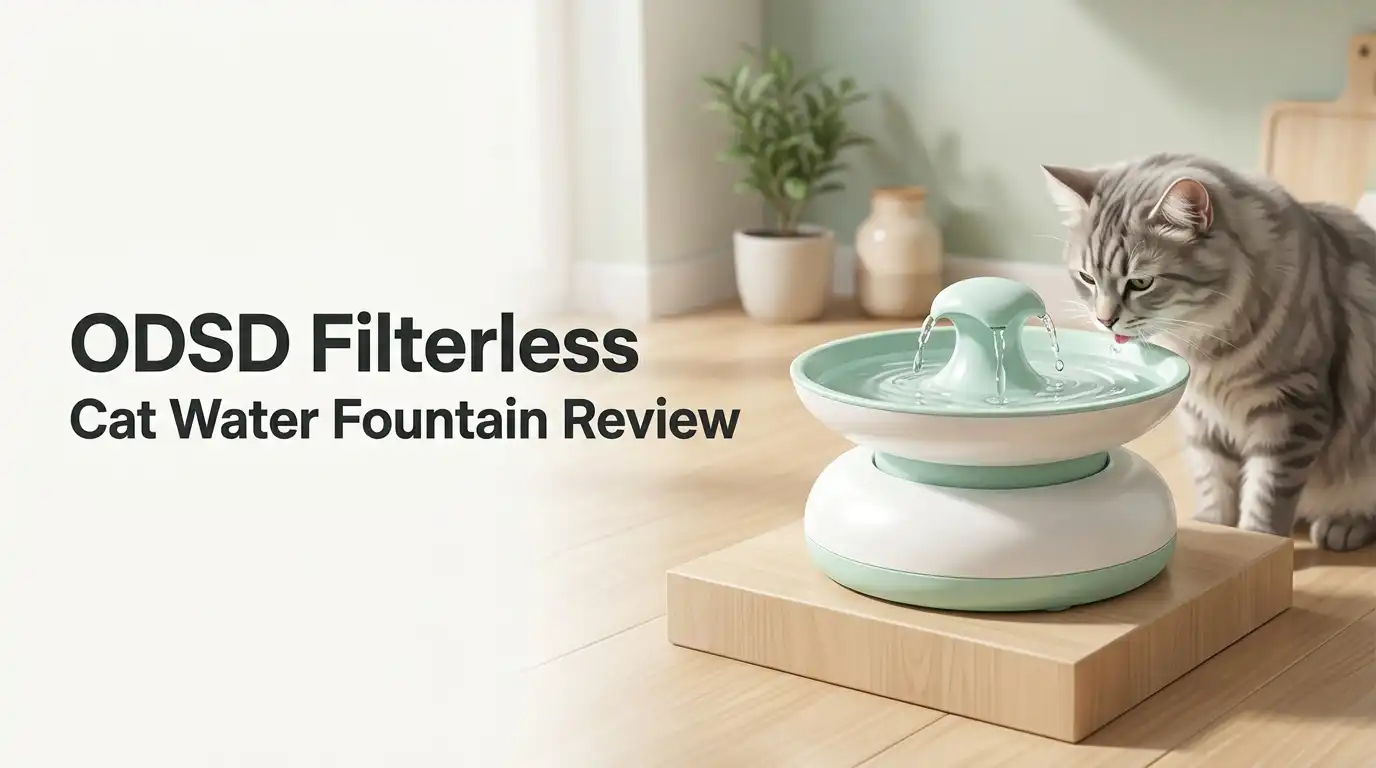
ODSD Filterless Cat Water Fountain Review 2026: Worth It?
Most cat owners hate one thing about pet fountains. The slime. That pink film creeps back two days after every deep clean, and the replacement filters cost more than the fountain over a year.
The ODSD Filterless Cat Water Fountain promises a different approach. It splits clean water and used water into two separate tanks, so the water your cat touches never cycles back into the fresh supply. No filter cotton. No monthly subscription. Just refill and drain.
That sounds great on paper. But this category is crowded with lookalike products sold under five different brand names, and buyer feedback is genuinely mixed.
In a Nutshell:
- The separation system works as advertised. Clean water sits in a 101oz (3L) tank. Used water drains into a separate 46oz (1.35L) tank. Your cat drinks fresher water than any recirculating fountain can offer.
- No filters ever. There is a reusable sponge that catches fur and crumbs, but it is not a water filter. You rinse it instead of replacing it. Expect to save roughly $40 to $60 a year compared to filter based models.
- Battery life is strong, app access is not. The 5000mAh battery runs over 14 days in sensing mode. But here is the catch most listings bury: app features only work while the fountain is plugged in. Run it cordless and your phone goes blind.
- It is genuinely quiet. ODSD rates it under 25dB. In a silent bedroom at night, I heard a faint trickle and nothing else. No pump whine.
- Reliability is the real question mark. Buyer reports include spotty flow, water pooling on the floor, and units failing after a few months. This is the weak spot, and no amount of clever design fixes it.
- Daily draining is part of life. The wastewater tank fills faster than you expect with two cats. Plan on emptying it every day or two.
ODSD Filterless Cat Water Fountain

Last update on 2026-10-30 / Affiliate links / Images from Amazon Product Advertising API
The ODSD arrives as a chunky white or blue tower with a stainless steel drinking tray on top. The model number is P500. It holds 101oz of clean water in the upper tank and routes everything your cat has touched into a 46oz tank below.
Material is food contact ABS plastic with a steel tray where the mouth meets the water, which is the right place to put metal if you are only using it in one spot.
Two flow modes are included. Smart sensing starts the flow when your cat walks up. Continuous mode keeps water moving all the time.
The unit weighs under 4 pounds packed, so it is easy to carry to the sink. It is built for cats and small pets only. ODSD states clearly that large dogs are outside the design limits, and the small tray backs that up.
Unboxing Experience
The box is plain brown with a product photo on one face. Nothing fancy. Inside you get the fountain body, a stainless steel tray, a power adapter, a USB charging cable, and a thin paper manual. That is the whole kit. No stickers, no starter filters, no extra sponge.
The fountain ships mostly assembled, which I appreciated. The tanks snap apart with a firm twist rather than clipping into place with latches. First impression on build quality was mixed.
The steel tray feels solid and has real weight. The plastic body feels light and hollow, closer to a $30 appliance than a $70 one. The seams line up well enough, but you can flex the lid with light pressure.
The manual deserves a complaint. It uses tiny diagrams and translated text that skims over the drainage cycle entirely. Watch a setup video before you fill it. You will understand the water path in two minutes instead of twenty.
How the Wastewater Separation Works
This is the whole point of the product, so it helps to picture it. A small pump lifts clean water from the sealed upper tank into the stainless tray. Your cat drinks. Saliva, fur, and food particles land in that tray. Instead of pulling that water back through a filter and into the main tank, the fountain drains the tray down into a sealed wastewater chamber.
The two water bodies never mix. That is the mechanical reason biofilm builds slower here than in a traditional fountain. In a recirculating design, one cat drinking seeds the entire reservoir with bacteria, and the pump then spreads it around for days.
The tradeoff is volume. Every cycle moves clean water one direction only. A fountain that holds 101oz of fresh water does not give you 101oz of drinking time, because the system discards water after exposure. You refill more often than a recirculating fountain of the same size.
Top 3 Alternative for ODSD Filterless Cat Water Fountain


Last update on 2026-10-30 / Affiliate links / Images from Amazon Product Advertising API
FEELNEEDY Wireless Cat Water Fountain No Filters

Last update on 2026-10-30 / Affiliate links / Images from Amazon Product Advertising API
Meowant Cat Water Fountain Filterless Wastewater Separation

Last update on 2026-10-30 / Affiliate links / Images from Amazon Product Advertising API
PETLIBRO Cat Water Fountain Stainless Steel Tray Wireless Pump
Design and Build Quality
The ODSD stands about 8.5 inches wide and sits low, which suits cats who dislike reaching up. The drinking tray is shallow and wide, so whiskers clear the sides comfortably. My older cat has whisker sensitivity and she had no issue with it.
The steel tray lifts out by hand and goes straight into the sink. The main unit is not washable. You wipe it with a cloth, which is a real limitation when the internal hose is where gunk likes to hide.
The plastic is the honest weak point here. It is food contact grade and safe, but it scratches, it stains slightly with hard water, and it does not inspire confidence over a multiyear horizon.
The water level sensor sits in the tray and needs wiping, because debris on the sensor causes false readings and erratic flow. That small detail explains a lot of the frustrated reviews floating around.
Setup and First Fill
Setup takes about ten minutes if you read ahead. Rinse every removable part. Seat the sponge in its slot. Fill the clean tank to the marked line, snap the tray in place, and plug it in. Charge it fully before the first cordless run.
The fountain primes itself within a minute or so. You hear a short pump cycle, then water appears in the tray. Do not panic if the tray drains immediately on the first run. The system does a clearing cycle before it settles.
Place it on a hard floor, not carpet. Minor splashing happens, and a few owners report pooling under the unit when the tray seal is not seated perfectly. A silicone mat underneath solves that cheaply. Keep it away from food bowls too, since kibble crumbs are the fastest route to a blocked sensor and a stalled pump.
App Monitoring and Smart Features
The app connects over 2.4GHz WiFi. Setup followed the usual pattern: install, create an account, hold the pairing button, and wait. Mine connected on the second attempt.
Once paired, you see clean water level, wastewater level, and current mode. You can set drainage schedules and build simple automations. Notifications tell you when the clean tank is low or the waste tank is full, and those alerts are genuinely useful.
Now the big asterisk. App functions require the fountain to stay plugged in. The moment you unplug it and run on battery, monitoring stops.
That undercuts the main selling point of a cordless fountain, because the whole reason to go cordless is placing it where there is no outlet. You get smart features or you get cord freedom, not both at once. ODSD does disclose this, but only in the fine print.
Battery Life and Power Options
The built in 5000mAh battery is the strongest hardware spec on this fountain. In smart sensing mode, ODSD claims more than 14 days per charge. My real world result landed close to that, around twelve days with two cats triggering it regularly. Continuous flow mode drains it far faster, closer to four or five days.
The fountain also runs on mains power through the included adapter. If the power drops out, it switches to battery automatically. That failover is a nice safety feature for anyone who leaves cats alone during a work trip.
Recharging takes several hours over USB. There is no fast charge. My practical advice is to keep it plugged in most of the time and treat the battery as backup plus travel flexibility. That way you also keep the app alive, which is the sensible compromise.
Noise Level in Real Use
ODSD rates the pump at under 25dB, described as quieter than a whisper. I was skeptical. I was also wrong to be.
In a quiet room, the pump itself is close to inaudible. What you hear is the water falling into the steel tray, which is a soft trickle rather than a splash. At night in a bedroom, it registered as background texture and did not wake me.
Smart sensing mode makes it quieter still, because the pump only runs when a cat approaches. If you work from home or sleep lightly, this mode is the one to use.
One caveat. Noise increases noticeably when the clean tank runs low, because the pump works harder and starts pulling air. A sudden gurgling sound is usually your cue to refill, not a sign of failure.
Cleaning and Maintenance
Cleaning is simpler than a filter fountain, but it is not zero effort. The tray, tanks, bowl, and sponge all detach and rinse under the tap. A soft brush handles the corners. Total time runs about five minutes for a quick clean.
The sponge catches hair and debris. It does not purify water. Rinse it every few days and replace it when it loses shape.
The internal hose is the problem area. This is the same complaint that follows every fountain in this category. You cannot reach inside the tube easily, and over months that is where residue accumulates. A flexible straw brush helps a lot and costs a few dollars.
Drain the wastewater tank daily if you have two or more cats. Letting it sit is how you reintroduce exactly the smell you bought this fountain to avoid.
Did My Cats Actually Drink From It
Acceptance took about four days. My younger cat approached on day one, triggered the sensor, and backed off at the sound. By day three he was drinking normally. My older cat needed the old bowl left out alongside it for a week.
Smart sensing mode is the hurdle for nervous cats. Water appearing suddenly startles some of them. Switching to continuous flow for the first few days removes the surprise, and you can swap back later.
Flow rate is gentle rather than dramatic. There is no tall arcing stream like a faucet. Cats who specifically love the bathroom tap may find this underwhelming, and that is a fair expectation to set. If your cat ignores every fountain you have ever bought, this one is unlikely to change their mind by itself.
Pros and Cons
Pros
- Clean and used water stay fully separated, which slows biofilm and keeps drinking water noticeably fresher between refills.
- Zero ongoing filter costs, with only a reusable sponge to rinse and occasionally replace.
- Very quiet operation under 25dB, suitable for bedrooms and small apartments.
- Strong 5000mAh battery delivering roughly two weeks in smart sensing mode, with automatic failover if mains power drops.
- Stainless steel drinking tray that lifts out and cleans in seconds.
- Useful app alerts for clean and waste water levels, plus custom drainage scheduling.
Cons
- App features stop working on battery power, which cancels out much of the cordless appeal.
- Reliability complaints are common, including spotty flow, units failing after a few months, and water escaping onto the floor.
- Mostly ABS plastic construction that feels light for the price.
- Internal hose is awkward to clean and becomes the hidden grime spot over time.
- Wastewater tank needs emptying daily in multicat homes.
- Weak instruction manual with unclear diagrams.
- Nearly identical fountains sell under several brand names, which makes support and spare parts uncertain.
What This Fountain Does Not Do Well
Honesty matters more than enthusiasm here. Durability is the biggest concern with the ODSD. Buyer feedback repeatedly mentions units that stopped working after a few months, inconsistent water flow, and leaking around the tray. Those are not cosmetic issues. They are the whole product.
Brand transparency is the second problem. This exact fountain design appears under multiple labels, and some of those listings have been pulled and relisted. That pattern makes warranty support and replacement parts a gamble.
It also does not solve the hose cleaning issue that plagues every pump fountain. Separation keeps the bowl fresher, but water still travels through a tube you cannot scrub properly.
Finally, it is not a dog product. The tray is small, the capacity drains fast, and ODSD says so directly.
Price and Value
The ODSD typically sells around $68.99, which places it in the middle of the smart fountain market. Filter based competitors cost less upfront but add roughly $40 to $60 a year in replacements, so the math closes the gap within eighteen months.
Compared against its own lookalikes, the ODSD is not clearly better. The FEELNEEDY version runs cheaper at a similar size. The HAPAW model offers nearly identical specs. If you find any of them discounted, the differences are small enough that price should decide it.
The value verdict depends on your tolerance for risk. If the unit survives two years, it is good value. If it fails at month four, it is an expensive lesson. Buy from a seller with a straightforward return window, and test it thoroughly during the first thirty days rather than setting it up and forgetting about it.
Who Should Buy It
This fountain suits a specific owner. You are tired of buying filters. You want fresher water without a weekly deep scrub. You have a hard floor, an outlet nearby, and one or two cats rather than four.
It is a good match for people who already accept daily maintenance and simply want that maintenance to be faster. Emptying a waste tank beats scrubbing pink slime out of a reservoir.
Skip it if you need true cordless operation with app monitoring, because those two features cannot run at the same time. Skip it if you want a premium all metal build, since this is plastic with a steel tray. Skip it if your cat has already rejected three fountains, because the gentle flow here is unlikely to win them over.
Final Verdict
The ODSD Filterless Cat Water Fountain gets the core idea right. Separating clean water from used water is a smarter approach than recirculating everything through a sponge, and the fresher drinking water is noticeable within the first week. The quiet pump, the strong battery, and the steel tray are all real strengths.
The execution is where it stumbles. The plastic body feels cheap, the app locks itself to plug in mode, and the reliability record is uneven enough that you should treat the return window as part of the purchase.
My rating sits at a cautious recommendation. If the concept appeals and you can return it easily, it is worth trying. If you need something you can trust for years without thinking about it, the market does not have a confident answer in this category yet.
Frequently Asked Questions
Does the ODSD fountain really need no filters?
Correct. There is no filter cotton and nothing to replace on a schedule. The fountain includes a reusable sponge, but that sponge catches fur and food debris rather than purifying water. You rinse it every few days and replace it only when it falls apart. Water stays clean because used water drains into a separate tank instead of cycling back through the clean supply.
How often do I need to empty the wastewater tank?
The wastewater tank holds 46oz (1.35L). With one cat, every two or three days is usually enough. With two or more cats, daily emptying is better. Letting used water sit creates odour and defeats the purpose of the separation design. The app sends an alert when the tank reaches capacity, provided the fountain is plugged in.
Can I use the app while running on battery power?
No. App monitoring, notifications, and scheduling require the fountain to be connected to mains power. On battery, the fountain still runs both flow modes normally, but your phone cannot see water levels or status. Most owners keep it plugged in and treat the battery purely as backup.
Is this fountain suitable for dogs?
ODSD designed it for cats and small pets. The drinking tray is shallow and the clean tank empties quickly under heavy use, so a medium or large dog will drain it within hours. Small dogs under roughly 15 pounds can manage, but larger breeds should use a dedicated dog fountain with a bigger reservoir.
Why is my water flow stopping or behaving strangely?
The most common cause is debris on the water level sensor inside the tray. Wipe the sensor surface with a soft cloth and rinse the tray. A low clean water tank also causes the pump to pull air and stutter. If both are fine and the flow is still unreliable, the pump or hose may be blocked, and that is worth a return rather than a repair attempt.

Hi, I’m Liza — pet lover, lifelong animal enthusiast, and the voice behind Liza4Pets. I created this space to share honest, practical pet care advice for fellow pet parents who want the best for their furry (and not-so-furry) companions.