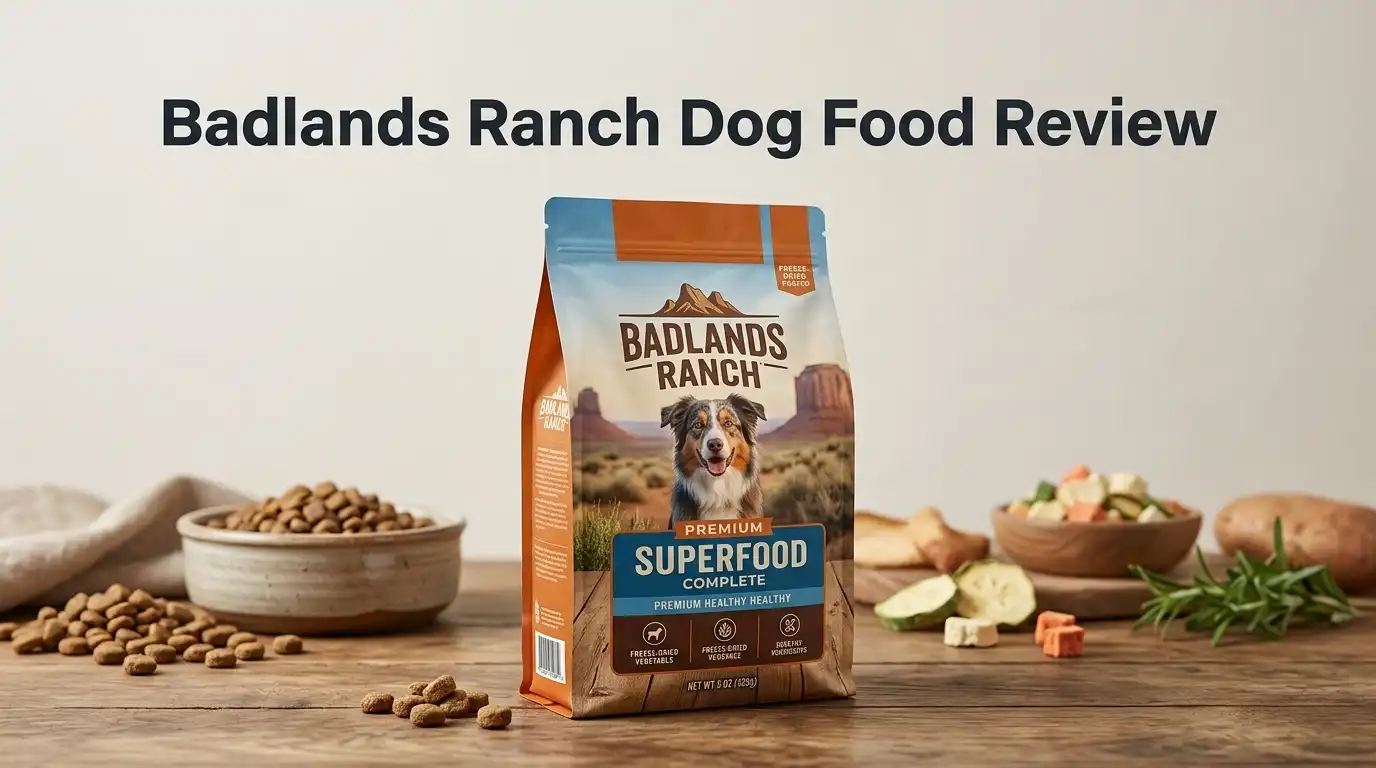
Badlands Ranch Dog Food Review 2026: Worth It?
Your dog stares at the same bowl of brown kibble every morning. You wonder if there is something better. Badlands Ranch promises exactly that. The brand sells air dried food made with 87 percent meat, organs, and salmon.
Actress Katherine Heigl founded the company in 2022 and named it after her family ranch in Utah. The bags cost a lot. The marketing is everywhere. Social media ads show glossy coats and happy seniors bouncing around like puppies.
This review covers what I found, including the parts the brand does not advertise. You will get the good, the bad, and the expensive.
Key Takeaways
- The ingredient panel is genuinely strong. Beef, beef liver, beef heart, and salmon lead the list. There is no corn, wheat, soy, or unnamed meat meal. Independent reviewers score it around 8 out of 10, which puts it in low risk territory.
- The price is the biggest problem. Expect roughly $5.50 to $6.50 per pound depending on bag size and retailer. Feeding a 50 pound dog exclusively costs serious money each month. Most owners use it as a topper instead.
- Picky dogs usually love it. The soft, chewy, jerky like texture wins over dogs that refuse kibble. A small number still reject it, especially tiny breeds.
- Carbohydrates sit near 24 percent, which is high for an air dried food. Sweet potato and pumpkin drive that number up.
- Direct subscriptions frustrate people. The BBB profile holds real complaints about billing and refunds. Buying single bags from Amazon or Chewy avoids that headache entirely.
- There have been no recalls of Superfood Complete to date, which matters in a category full of safety scares.
What Is Badlands Ranch Superfood Complete?

Last update on 2026-10-30 / Affiliate links / Images from Amazon Product Advertising API
Superfood Complete is an air dried dog food. Air drying sits between kibble and raw. The company cooks the recipe low and slow, pulling moisture out with gentle warm air instead of high pressure extrusion. The result looks like soft crumbles of meaty jerky. You scoop it like kibble. You store it in a pantry. No freezer required.
The brand launched with a single beef recipe in 2022. The lineup grew since then. You can now buy Beef, Chicken, Lamb and Venison, Beef and Bison, and Wild Fish and Turkey.
Each formula follows the same blueprint. Roughly 87 percent of the food comes from animal sources. The remaining 13 percent brings in seeds, vegetables, fruit, and canine specific superfoods like lion’s mane mushroom and turmeric.
The pitch is simple. You get whole food nutrition with the convenience of a bagged product. No thawing. No mess. No raw handling worries. The food works as a full meal or as a topper sprinkled over your dog’s current diet.
Bag sizes range from a small 11.5 ounce trial pouch up to a 20 pound box. The 64 ounce bag is the most common choice for medium dogs. Superfood Complete carries an AAFCO statement for adult maintenance, so it is complete and balanced for grown dogs.
Puppies need a different food. That detail gets buried in the marketing, so read the panel before you buy for a young dog.
The Unboxing Experience: What Arrives At Your Door
My 64 ounce bag arrived in a plain brown box with a branded insert card. No fancy packaging theater. Inside sat a matte black stand up pouch with a photo of a dog on the front and a resealable zipper along the top.
The bag felt heavier than expected. Air dried food is dense, so four pounds takes up less space than four pounds of kibble.
Cutting the seal released the smell immediately. This food smells like beef jerky and liver. It is strong. It is not unpleasant, but it is not subtle either. My kitchen carried the scent for about ten minutes. Both dogs appeared in the doorway within seconds. That reaction alone told me something about palatability.
The texture surprised me most. The pieces are soft crumbles, not hard nuggets. They break apart between your fingers. Some chunks are pea sized. Others are larger flakes.
The bottom of the bag holds a fair amount of dust and small fragments. If your dog eats slowly, that dust settles in the bowl and gets left behind. A splash of warm water fixes that and turns the crumbles into a gravy like mash.
The zipper works well and seals tight. The brand recommends using the bag within three months after opening. Shelf life runs 18 months unopened. One small annoyance: no scoop is included. You supply your own measuring cup, which matters because portions here are smaller than kibble portions.
Ingredients Breakdown: What Is Actually Inside The Bag
The beef recipe ingredient list reads well. Here is the opening sequence: beef, beef liver, beef heart, salmon, flaxseed, sweet potato, pumpkin, carrots, calcium carbonate, broccoli, chia seeds, blueberry, ginger, salt, turmeric, and lion’s mane mushroom. After that comes the vitamin and mineral pack.
Four animal ingredients lead the list. That is a genuine strength. Beef heart delivers taurine, which supports heart function. Beef liver packs vitamin A, copper, and B vitamins in natural form. Salmon contributes omega 3 fatty acids for skin and coat. You will not find chicken by product meal, corn gluten, or generic “meat and bone meal” anywhere.
Now the honest criticism. The company does not state whether the salmon is farmed or wild caught. Farmed salmon carries a different fatty acid profile and less nutritional value. The brand also skips publishing an omega 6 to omega 3 ratio, which makes it hard to judge the anti inflammatory value of the fish.
Carbohydrate content runs around 24 percent as calculated. That is high for a food positioned as a raw alternative. Sweet potato and pumpkin are the culprits. They are decent ingredients, but large amounts of starch can raise insulin and affect gut balance in sensitive dogs.
The long synthetic vitamin list is another sticking point. Ideally a food built on organs and whole produce would need fewer added nutrients. The pack here is smaller than a typical kibble premix, but it is still there.
Guaranteed Analysis And Calorie Math
Numbers matter more than marketing copy. The beef formula lists crude protein at a minimum of 30 percent, crude fat at a minimum of 14 percent, crude fiber at a maximum of 5 percent, and moisture at a maximum of 15 percent.
Other formulas shift. The Wild Fish and Turkey recipe pushes protein higher, around 38 percent minimum. Always read the panel on the specific bag you buy, because these figures vary by recipe and by bag run.
Calorie density sits near 370 to 420 kcal per cup depending on formula. That is higher than most dry foods, which typically land between 340 and 400 kcal per cup with far less meat behind those calories. The practical effect is smaller portions. A cup here goes further than a cup of grocery store kibble.
Dry matter protein works out to roughly 35 percent. That is respectable. It is not class leading. Some competing air dried foods hit 40 percent or more.
Fat at 14 percent minimum is moderate, which actually helps dogs prone to pancreatitis. Several premium air dried brands run fat near 30 percent, and that level causes real trouble for sensitive dogs.
One thing worth flagging: air dried foods tend to carry higher sodium than kibble. Salt appears in the ingredient list. Dogs with heart disease or kidney concerns should get veterinary clearance before switching. The company does not publish a sodium percentage on the front of the bag, which is a transparency gap.
Top 3 Alternatives for Badlands Ranch Superfood Complete


Last update on 2026-10-30 / Affiliate links / Images from Amazon Product Advertising API
ZIWI Peak Air Dried Dog Food Beef Recipe

Last update on 2026-10-30 / Affiliate links / Images from Amazon Product Advertising API
Stella and Chewy’s Freeze Dried Raw Dinner Patties Beef Recipe

Last update on 2026-10-30 / Affiliate links / Images from Amazon Product Advertising API
The Honest Kitchen Wholemade Whole Grain Chicken Recipe Dehydrated Dog Food
Badlands Ranch Air Dried Beef 24 Ounce Bag

Last update on 2026-10-30 / Affiliate links / Images from Amazon Product Advertising API
The 24 ounce bag is the smart starting point. I recommend it over the large size for anyone testing the water. You get enough food for a real trial without committing to a four pound investment that might end up in the trash.
For a 20 pound dog eating one full cup daily, this bag lasts roughly eight to nine days as a complete meal. Used as a topper at a quarter cup per meal, the same bag stretches close to a month. That topper approach is how most owners actually use this product, and it is the approach I suggest for anyone watching a budget.
The bag design matches the larger size. Resealable zipper, matte finish, clear feeding chart on the back. The chart breaks portions down by body weight from 5 pounds through 80 pounds and beyond. A 50 pound dog needs 1 and three quarters to 3 cups per day, which shows how quickly a small bag disappears with a big dog.
Freshness is the hidden benefit here. Air dried food degrades once oxygen hits it. The fats oxidize. The smell fades. Dogs notice.
A smaller bag finished within two or three weeks stays aromatic and appealing the whole way through. Owners who buy the biggest bag to save money often report their dog losing interest in the final third.
Price per pound is higher on the small bag. You pay for the flexibility. I still think it is the right first purchase because a rejected large bag costs far more than a rejected small one.
Feeding Guide: How Much Your Dog Actually Needs
The feeding chart is straightforward. A 5 pound dog eats one third to one half cup daily. A 15 pound dog eats two thirds to 1 and a quarter cups.
A 20 pound dog eats 1 to 1 and a half cups. A 30 pound dog eats 1 and a quarter to 2 cups. A 50 pound dog eats 1 and three quarters to 3 cups. A 70 pound dog eats 2 and a half to 4 cups.
Those ranges are wide for a reason. Activity level changes everything. A couch bound senior needs the bottom of the range. A working border collie needs the top. Start in the middle, then adjust after two weeks based on body condition. You should feel ribs under a thin layer of fat without seeing them.
Transition slowly. This is the single biggest mistake owners make. Several owners reported watery stools after switching cold turkey, then blamed the food.
Go 25 percent new food for three days, 50 percent for three days, 75 percent for three days, then full switch on day ten. Older dogs and sensitive stomachs may need two full weeks.
Adding water is optional but useful. A tablespoon of warm water per quarter cup softens the crumbles, releases more aroma, and adds hydration. This helps seniors with dental problems and dogs that gulp their food.
Split the daily amount into two meals. Air dried food is calorie dense. One large serving can overwhelm a small stomach. Two smaller meals digest better and reduce the odds of loose stool during the adjustment period.
My 30 Day Feeding Test: Honest Results
I ran a full month with a 42 pound mixed breed and a 12 pound terrier. Both started as toppers at 25 percent of daily calories, then moved to 50 percent by week three. Neither went fully exclusive, mostly because of cost.
Week one brought immediate enthusiasm. Both dogs cleared their bowls faster than usual. The terrier, historically a picky eater who leaves kibble sitting until evening, ate within two minutes. That alone was notable.
Week two was the rough patch. The larger dog had two soft stool days around day nine. I slowed the transition, held at 25 percent for four extra days, and the issue resolved. This is normal for a high meat food and not a defect, but it is worth knowing before you panic.
Weeks three and four showed the changes people talk about online. Stool volume dropped noticeably, which makes sense given the low filler content. Breath improved on both dogs, a change my family commented on without being asked. Coat shine improved modestly on the terrier by day 28, less so on the mixed breed.
What did not change: energy levels stayed roughly the same. Both dogs were already active. Claims about seniors “acting like puppies” did not apply here. I also saw no change in seasonal itching on the larger dog, matching reports from owners who bought the food specifically for skin problems and came away disappointed.
Overall the month was positive but not miraculous. The improvements were real and modest.
What Badlands Ranch Does Not Do Well
Authentic reviews cover failures. Here are the weak points I found.
The cost is hard to justify for large dogs. Feeding a 70 pound dog exclusively burns through a 64 ounce bag in about four days. Do that math and the monthly figure becomes uncomfortable for most households. The brand knows this, which is why so much of its messaging pushes the topper use case.
Direct subscription billing generates real complaints. The Better Business Bureau profile contains multiple grievances about unwanted recurring shipments, difficulty canceling, and refund disputes.
One documented case involved a customer being told a full refund required returning empty bags, a condition that was not obvious at purchase. Customer service often resolves these, but only after phone calls.
The 90 day guarantee has conditions attached. Read them. Partial refunds on opened bags catch people off guard.
Carbohydrate content is higher than the raw alternative positioning suggests. At roughly 24 percent, this is not a low carb food. Owners managing canine diabetes or weight problems should look elsewhere.
Not every dog eats it. Chihuahua and Pomeranian owners in particular reported flat refusals. The strong liver smell that attracts most dogs repels a minority.
It is adult maintenance only. No puppy formula exists. Large breed puppies especially need controlled calcium, and this is not the food for them.
Availability at physical stores is patchy. Some independent pet shops carry it. Big chains often do not.
Price Check: Cost Per Day And Where To Buy
Let me put real numbers on the table. Direct from the company, a single bag runs about $59.95 at full price, dropping near $40.95 with membership pricing on multi bag orders.
Chewy lists the 64 ounce bag around $64.99, which works out to roughly $6.50 per pound. The 20 pound box lands near $109.99, or about $5.50 per pound. Independent retailers price the 24 ounce bag anywhere from $17.90 to $27.99 depending on the store.
Buy the biggest size you can finish in three months. The per pound savings are significant. A 20 pound box costs about 15 percent less per pound than a 64 ounce bag.
Here is the daily cost reality. A 20 pound dog eating 1.25 cups per day uses roughly 0.3 pounds of food daily. At $6.00 per pound, that is about $1.80 per day, or $54 per month. Reasonable. A 70 pound dog eating 3.25 cups uses about 0.8 pounds daily, which pushes past $140 per month.
The topper strategy changes the equation completely. A quarter cup twice daily costs roughly 70 cents per day regardless of dog size. That gets you better palatability and some nutritional upgrade for the price of a coffee each week.
Amazon and Chewy both avoid the subscription friction that generates the company’s worst reviews. You pay slightly more per bag than the deepest membership discount, but you keep control of your own billing. For most buyers that tradeoff is worth it.
Pros And Cons Of Badlands Ranch Dog Food
Pros
- Meat leads the ingredient list four times over. Beef, beef liver, beef heart, and salmon occupy the top four slots, which is rare at any price point.
- No corn, wheat, soy, artificial preservatives, or unnamed meat meals appear anywhere in the formula.
- Palatability is excellent for most dogs. The soft jerky texture and strong aroma convert a high percentage of picky eaters.
- Moderate fat content near 14 percent makes it safer for dogs prone to pancreatitis than many competing air dried foods running 30 percent fat.
- Zero recalls to date, which is meaningful in a category that sees frequent safety alerts.
- Five protein options let you rotate proteins or avoid a specific allergen like chicken.
- Shelf stable storage means no freezer space and no raw handling protocols.
- Smaller stool volume was consistent across my test and across owner reports.
Cons
- Price is steep, roughly $5.50 to $6.50 per pound, which makes exclusive feeding impractical for large dogs.
- Carbohydrates sit near 24 percent, higher than expected for a raw style food.
- Salmon sourcing is undisclosed. No word on farmed versus wild caught.
- Subscription and refund complaints are well documented on the BBB profile.
- No puppy formula exists. The AAFCO statement covers adult maintenance only.
- A long synthetic vitamin pack suggests the whole food ingredients alone do not meet the nutrient profile.
- Sodium levels are not published clearly, a concern for dogs with heart or kidney issues.
- Some small breeds refuse it outright despite the strong aroma.
- Bag dust accumulates at the bottom and often gets left in the bowl.
Badlands Ranch Versus Kibble Versus Freeze Dried Raw
Understanding the category helps you decide. Standard kibble goes through extrusion, a high heat high pressure process that destroys some nutrients and requires starch to hold the shape together. Kibble is cheap, shelf stable, and convenient. Quality ranges enormously.
Freeze dried raw removes moisture at freezing temperatures under vacuum. Almost no heat touches the food. Nutrient retention is the highest of any shelf stable option. Freeze dried raw also costs the most, often double what air dried costs per pound.
Air dried food sits in the middle. Warm air circulates over the food for hours, removing moisture gradually. Some heat sensitive vitamins, enzymes, and amino acids degrade. Independent reviewers dock points for this. The upside is a shelf stable product that keeps more nutrition than kibble at a lower price than freeze dried raw.
Where does Badlands Ranch land? It is a solid mid tier air dried option. Ziwi Peak offers higher meat percentage and lower carbs but costs more and runs much higher in fat. Stella and Chewy’s freeze dried patties preserve more nutrition but require crumbling and cost more per calorie. The Honest Kitchen dehydrated option is cheaper per serving but requires adding water and waiting.
The honest positioning is this: Badlands Ranch is a good upgrade from mid tier kibble and a step down from true freeze dried raw. It is not the most nutritionally dense product on the shelf. It is one of the more palatable and easier to use ones.
Who Should Buy It And Who Should Skip It
Buy it if you own a small or medium dog. The economics work. A 15 to 30 pound dog can eat this exclusively without wrecking your budget.
Buy it if your dog refuses everything. The conversion rate on picky eaters is the strongest thing about this product. If you have thrown away four bags of expensive food already, a 24 ounce trial bag is a reasonable gamble.
Buy it if you want a topper upgrade. Adding a quarter cup to decent kibble raises the meat content, improves palatability, and costs little. This is the highest value use case by far.
Buy it if your dog needs moderate fat. Dogs with pancreatitis history do better here than on the 30 percent fat air dried competitors.
Skip it if you own a large or giant breed. The monthly cost of exclusive feeding is genuinely unreasonable for a 70 pound dog, and I will not pretend otherwise.
Skip it if your dog is a puppy. No growth formula exists.
Skip it if you need low carbohydrate food. Diabetic dogs and dogs on strict weight programs need something else.
Skip it if you hate subscription friction. Buy from a third party retailer instead, or choose a brand with simpler purchasing.
Skip it if your dog has heart or kidney disease until your veterinarian reviews the sodium content with you.
Recalls, Safety, And Company Background
Safety record matters more than any marketing claim. Superfood Complete has never been recalled. That covers the period from its 2022 launch through the present. In a category where recalls happen regularly, a clean record deserves credit.
The company operates out of California. Katherine Heigl founded it and remains the public face. The brand produces in small batches, which limits the scale of any single contamination event. The Heigl family channels a portion of proceeds to its animal rescue foundation and donates food monthly to shelters.
You should still stay alert. Social media occasionally circulates claims linking the food to illness. Those posts are anecdotal, unverified, and usually lack veterinary diagnosis. No regulatory action has followed any of them. That said, any high meat food can trigger digestive upset if introduced too quickly, and some of those reports likely stem from rushed transitions.
Sourcing transparency is average, not excellent. The company describes its beef as humanely raised. It does not publish a full supplier list or country of origin for every ingredient. Competitors like Open Farm publish lot level traceability. Badlands Ranch does not.
Third party quality scoring places the food at 8 out of 10 with a low risk classification. The deductions come from carbohydrate level, added synthetic nutrients, and the moderate processing involved in air drying. None of those are safety red flags. They are quality refinements that a premium priced food arguably should address.
Final Verdict: Is It Worth Your Money In 2026?
Badlands Ranch Superfood Complete is a good food at an uncomfortable price. That is the fairest one line summary I can offer.
The ingredient panel holds up under scrutiny. Four animal ingredients lead. No junk fillers appear. The safety record is clean. Dogs eat it eagerly, and picky eaters convert at an unusually high rate. My 30 day test produced real improvements in stool quality and breath, plus a modest coat improvement.
The problems are equally real. You pay premium pricing for a food carrying 24 percent carbohydrates and a synthetic vitamin pack. Salmon sourcing stays undisclosed. Large dog owners face a monthly bill that few can sustain. The direct subscription program has generated enough documented complaints that I would steer anyone toward Amazon or Chewy instead.
My recommendation: start with the 24 ounce bag. Use it as a topper over a solid base food. Watch your dog for two weeks. If you see the improvements and the cost fits, scale up to the larger bag or the 20 pound box for better per pound value.
Score: 7.5 out of 10. Strong ingredients, strong palatability, genuine results, held back by price and a few transparency gaps. It is not the miracle the ads promise. It is a legitimately good food that will make most dogs happier at breakfast.
Frequently Asked Questions
Is Badlands Ranch dog food complete and balanced?
Yes, for adult dogs. Superfood Complete carries an AAFCO statement for adult maintenance. You can feed it as a sole diet without adding anything else. It is not formulated for puppies or growth, so young dogs need a different food.
Has Badlands Ranch ever been recalled?
No. There have been no recalls of Superfood Complete since the brand launched in 2022. Occasional social media claims about illness exist, but none have led to regulatory action or a verified recall.
How much does Badlands Ranch cost per month?
It depends entirely on dog size. A 20 pound dog eating it exclusively costs roughly $50 to $60 monthly. A 70 pound dog can exceed $140 monthly. Using it as a topper at a quarter cup twice daily costs closer to $20 monthly regardless of dog size.
Can I mix Badlands Ranch with kibble?
Yes, and most owners do. Sprinkle it over your dog’s existing food or mix it in. Reduce the kibble portion slightly to avoid adding extra calories. This is the most affordable way to use the product.
Why is my dog having loose stool on Badlands Ranch?
Usually the transition happened too fast. This food has far more meat than typical kibble and the gut needs time to adjust. Slow down. Go back to 25 percent new food for four or five days, then increase gradually over two weeks.
Is Badlands Ranch better than Ziwi Peak?
They serve different dogs. Ziwi Peak has higher meat content and lower carbohydrates but runs near 30 percent fat, which is risky for dogs prone to pancreatitis. Badlands Ranch is more moderate in fat and slightly cheaper. Ziwi wins on pure nutrient density.
Does Badlands Ranch help with itchy skin?
Sometimes. The salmon content adds omega 3 fatty acids that support skin health. Owners report mixed outcomes. Some see clear improvement within a month. Others see none. If your dog has a chicken allergy, avoid the chicken formula and choose beef or lamb and venison.
How long does an opened bag stay fresh?
The company recommends using it within three months of opening. Unopened bags last 18 months from the manufacturing date. Keep the zipper sealed and store the bag somewhere cool and dry, away from sunlight.
Where is the best place to buy Badlands Ranch?
Amazon and Chewy are the easiest options and let you avoid the subscription enrollment that generates most customer complaints. The company website offers the lowest per bag pricing through membership, but you will be managing a recurring plan.
Can senior dogs eat Badlands Ranch?
Yes. The soft texture suits dogs with dental problems, especially when you add warm water. The moderate fat level works well for older dogs. Check with your veterinarian first if your senior has kidney or heart disease, since air dried foods tend to carry higher sodium.

Hi, I’m Liza — pet lover, lifelong animal enthusiast, and the voice behind Liza4Pets. I created this space to share honest, practical pet care advice for fellow pet parents who want the best for their furry (and not-so-furry) companions.